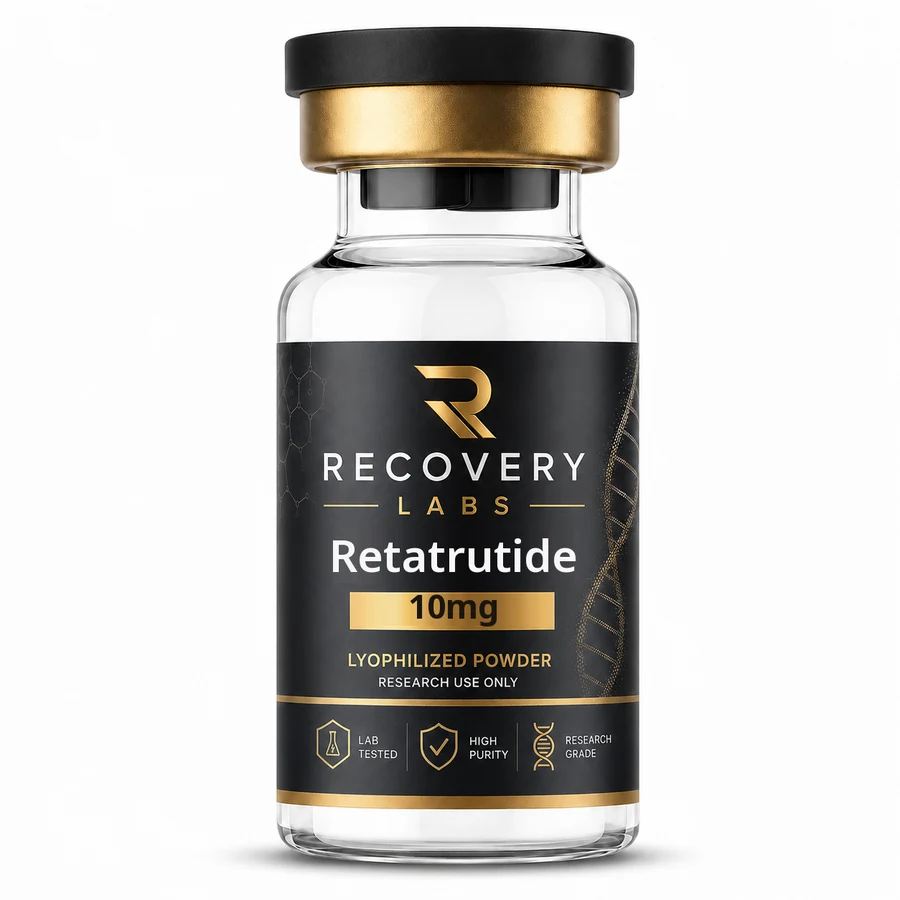
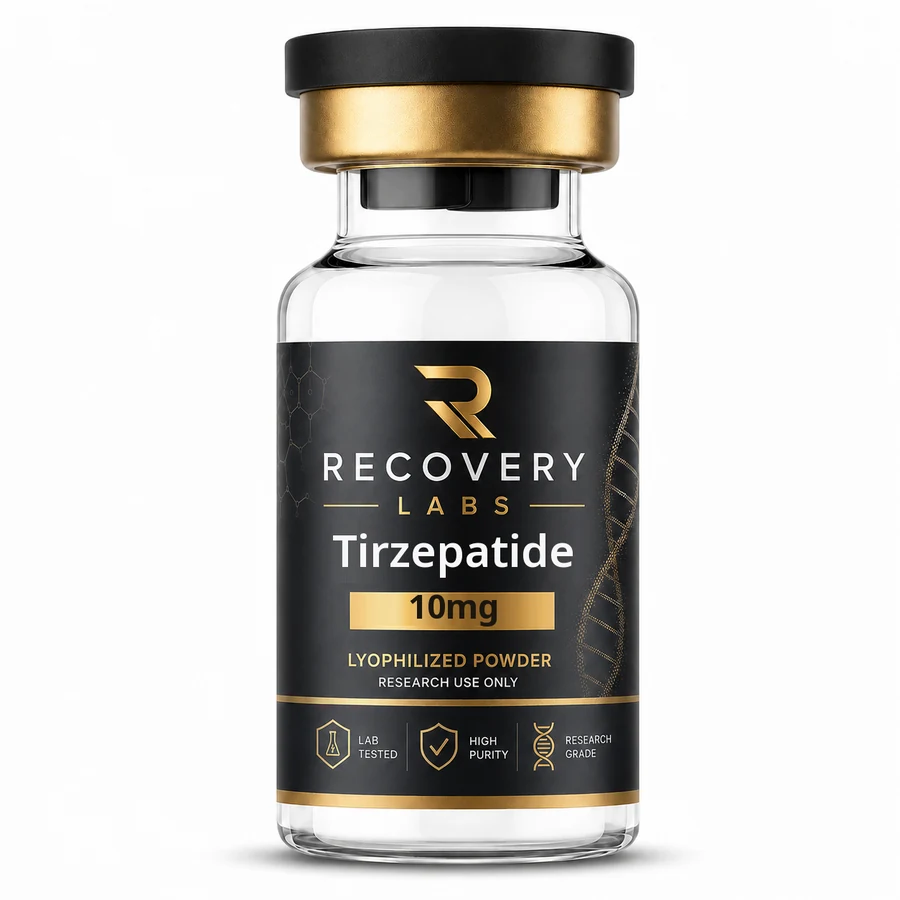
Mono-agonist, dual agonist, triple agonist. The three compounds get lumped together constantly and they are not interchangeable — structurally, pharmacologically, or analytically.
The incretin class went from one molecule to three headline molecules in under a decade, and the shorthand used to describe them has not kept up. "GLP-1" is now used as a catch-all for compounds that engage two and three receptors respectively. For research design, that shorthand is actively misleading.
Receptor targets at a glance
| Compound | Receptors engaged | Approx. residues | Documented half-life | Published top reference dose |
|---|---|---|---|---|
| Semaglutide | GLP-1 | 31 | ~7 days | 2.4 mg weekly |
| Tirzepatide | GIP + GLP-1 | 39 | ~5 days | 15 mg weekly |
| Retatrutide | GIP + GLP-1 + glucagon | 39 | ~6 days | 12 mg weekly |
Why the third receptor changes the experiment
Adding glucagon-receptor agonism introduces an energy-expenditure axis absent from the other two. In practice that means a retatrutide arm cannot be treated as a higher-potency tirzepatide arm — the endpoints you should be measuring differ, and hepatic readouts that were noise in a semaglutide design become signal.
Shared structural strategy
- All three use a fatty-acid diacid moiety for reversible albumin binding and extended circulation.
- All three carry backbone substitutions conferring DPP-4 resistance.
- All three are supplied lyophilised and are reconstituted with bacteriostatic water for laboratory work.
- All three are analytically demanding: long sequences mean deletion impurities co-elute readily.
Sourcing implications
The longer and more heavily modified the sequence, the more a supplier's release floor matters. Recovery Labs holds all three in Australia under a single 99% HPLC release standard with LC-MS identity on every lot, so a comparison study is not confounded by three different quality regimes.
Is retatrutide simply stronger than tirzepatide?
No. It engages an additional receptor, which changes the mechanism rather than only the magnitude. They are not dose-equivalent and should not be substituted for one another in a study design.
Do all three need the same storage conditions?
Broadly yes — lyophilised at -20 °C protected from light, reconstituted at 2–8 °C with a documented window of roughly 28–30 days.
Can one calibration curve cover all three?
No. Different masses and different chromatographic behaviour require separate calibration for each compound.